
Supply chain
Warehouse receipt loans rise 33% to Rs 5,697 crore in 2025-26
Pledge finance against e-NWRs rose 33% to Rs 5,696.56 crore in 2025-26, WDRA data show. Cumin and coriander are notified, but spice-specific data are thin.
Published · Data as of · 4 min read
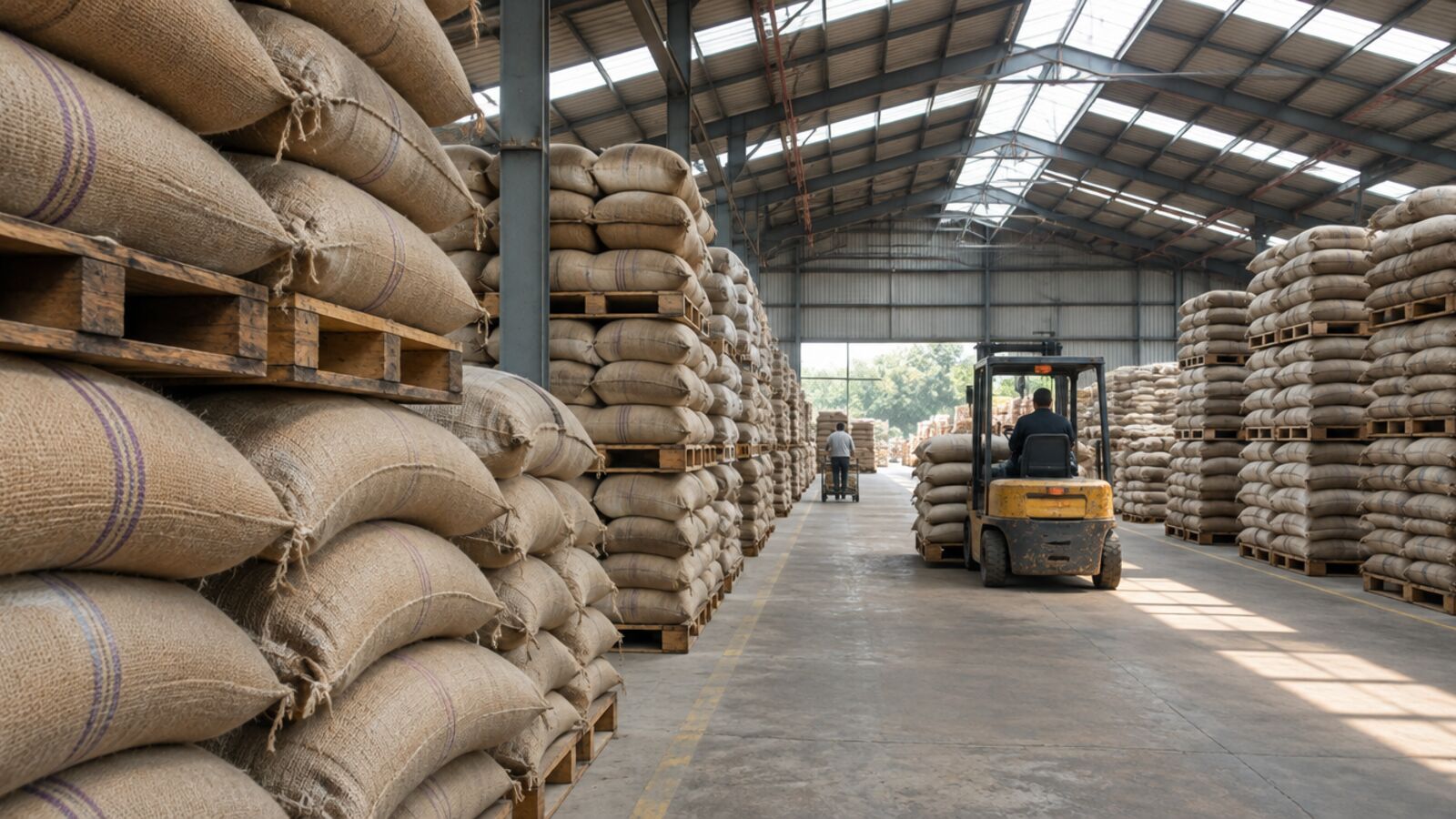
Bank loans against electronic negotiable warehouse receipts (e-NWRs) reached Rs 5,696.56 crore in 2025-26, up about 33% from Rs 4,271.61 crore a year earlier (calculated), according to the Warehousing Development and Regulatory Authority (WDRA) [1][2]. Cumin seed and dry coriander are both notified commodities under WDRA rules, so jeera and dhania stored in registered warehouses can be financed this way [2].
The system matters to the seed spice trade because jeera and dhania are harvested in a few weeks between February and April and sold over the following year. Holding stock is a financing decision as much as a price view. A receipt that a bank accepts as collateral lets a farmer, FPO or stockist wait for a better price instead of selling at harvest.
Registered capacity keeps growing
WDRA registered 1,681 warehouses in 2024-25, with combined capacity of about 116 lakh tonnes [2]. It had 6,166 active warehouses on 31 March 2025 with total capacity of 560.67 lakh tonnes [2]. The number of active warehouses rose to 7,512 by 31 March 2026 and 7,660 by 30 June 2026 [1][3].
| Measure | Figure | Period | Source |
|---|---|---|---|
| Pledge finance against e-NWRs | Rs 4,271.61 crore | 2024-25 | [2] |
| Pledge finance against e-NWRs | Rs 5,696.56 crore | 2025-26 | [1] |
| Pledge finance against e-NWRs | Rs 2,393.36 crore | Apr to Jun 2026 | [3] |
| Active registered warehouses | 6,166 | 31 Mar 2025 | [2] |
| Active registered warehouses | 7,660 | 30 Jun 2026 | [3] |
The pace is still well short of official targets. At the launch of a credit guarantee scheme for receipt loans, officials set a goal of 40,000 registered warehouses within one to two years and hoped post-harvest lending could reach Rs 5.5 lakh crore over 10 years [4]. WDRA's bulletin for January to March 2026 said Rajasthan, a major jeera and dhania growing state, had more than 400 registered warehouses [1].
The guarantee scheme lowers bank risk
The Credit Guarantee Scheme for e-NWR based Pledge Financing (CGS-NPF) has a Rs 1,000 crore corpus [4]. It covers loans of up to Rs 75 lakh for agricultural purposes and up to Rs 200 lakh for other borrowers such as FPOs, traders and MSMEs, WDRA says [5].
Coverage is 85% of a default for small, marginal, women and SC/ST/PwD farmers on loans up to Rs 3 lakh and 80% from Rs 3 lakh to Rs 75 lakh; other borrowers get 75% [5]. Farmers pay a guarantee fee of 0.40% a year and non-farmer borrowers 1% [5]. The scheme is run through a trust managed by the National Credit Guarantee Trustee Company [5].
WDRA has used bankers' workshops to push the product. Its April to June 2026 bulletin lists a State Level Bankers' Committee workshop in Jaipur on 5 June and farmer awareness programmes in Bundi, Kota and Gujarat's Anand district [3].
Exchange warehouses show where spice stock sits
WDRA does not publish commodity-wise e-NWR data for cumin or coriander in the bulletins reviewed [1][3]. The clearest public signal is stock held in NCDEX-accredited warehouses for futures delivery. BigMint reported exchange-monitored coriander stocks of 15,384 tonnes at Gondal and 1,506 tonnes at Kota in the week to 19 June 2026 [6]. Kedia Advisory said NCDEX coriander warehouse stocks had risen more than 150% in a month by 26 May [7].
For jeera, Kedia Advisory reported that NCDEX warehouse stocks rose nearly 9% in the month to 26 May 2026, without giving a level [8]. It said higher carryover stocks had reduced the urgency of traders and processors to buy [8].
What the trade is watching
The first marker is pledge finance in October to December 2026, when stockists decide whether to carry 2026 crop jeera and dhania into the new season. The second is warehouse registrations in Gujarat and Rajasthan, which decide how many seed spice growers can reach a registered store. The third is whether WDRA starts publishing commodity-level e-NWR data, which would show how much spice is actually financed on receipts. No such figure for jeera or dhania was found on any page opened for this article.
Questions and answers
Can farmers get a loan against stored jeera or dhania?
Yes. Cumin seed and dry coriander are notified commodities under WDRA, so produce stored in a WDRA-registered warehouse can be issued an electronic negotiable warehouse receipt and pledged to a bank for a loan.
What is the credit guarantee scheme for e-NWR loans?
The Credit Guarantee Scheme for e-NWR based Pledge Financing guarantees 75% to 85% of a default on eligible loans against warehouse receipts. It has a Rs 1,000 crore corpus and charges farmers a fee of 0.40% a year.
How large is warehouse receipt lending in India?
Pledge finance against e-NWRs was Rs 5,696.56 crore in 2025-26, according to WDRA, up from Rs 4,271.61 crore in 2024-25. A further Rs 2,393.36 crore was extended in April to June 2026.
Sources
- Warehousing Development and Regulatory Authority. WDRA Bulletin, Issue 14, January to March 2026, 2026-03-31.
- Warehousing Development and Regulatory Authority. Annual Report 2024-25, 2024-25.
- Warehousing Development and Regulatory Authority. WDRA Bulletin, Issue 15, April to June 2026, 2026-06-30.
- Warehousing Development and Regulatory Authority. Union Food and Consumer Affairs Minister launches Credit Guarantee Scheme for e-NWR based pledge financing (CGS-NPF), Undated (scheme launch release).
- Warehousing Development and Regulatory Authority. FAQs on Credit Guarantee Scheme, As accessed 2026-11-27.
- BigMint. India: Coriander prices rally as lower arrivals, fresh buying lift market sentiment, 2026-06-23.
- Kedia Advisory. Dhaniya report as on 26 May 2026, 2026-05-26.
- Kedia Advisory. Jeera report as on 26 May 2026, 2026-05-26.
Analysis by the India Spices Market editorial desk. For information only, not trading or investment advice.
Related
More from Intelligence.
Supply chain
El Nino and dry soils slow rabi sowing in India's jeera and dhania belt
26 November 2026 · 4 min read
Supply chain
Monsoon 2026 ends 13% short, leaving dry soils for jeera and dhania sowing
26 November 2026 · 4 min read
Supply chain
Steam sterilisation and colour sorting become musts for spice exporters
26 November 2026 · 4 min read
Read the market here. Meet it in Gandhinagar.
Every topic on this page is on the programme on 24 April 2027, with the people who move these prices in the room.
Registration opens 1 December 2026