
Supply chain
Jodhpur Jeera-1 beats GC-4 by 22.8% as three coriander varieties notified
Jodhpur Jeera-1 beat national check GC-4 by 22.8% in trials. A July 2026 gazette notified Karan Dhaniya-1 and two Navsari coriander varieties.
Published · Data as of · 4 min read
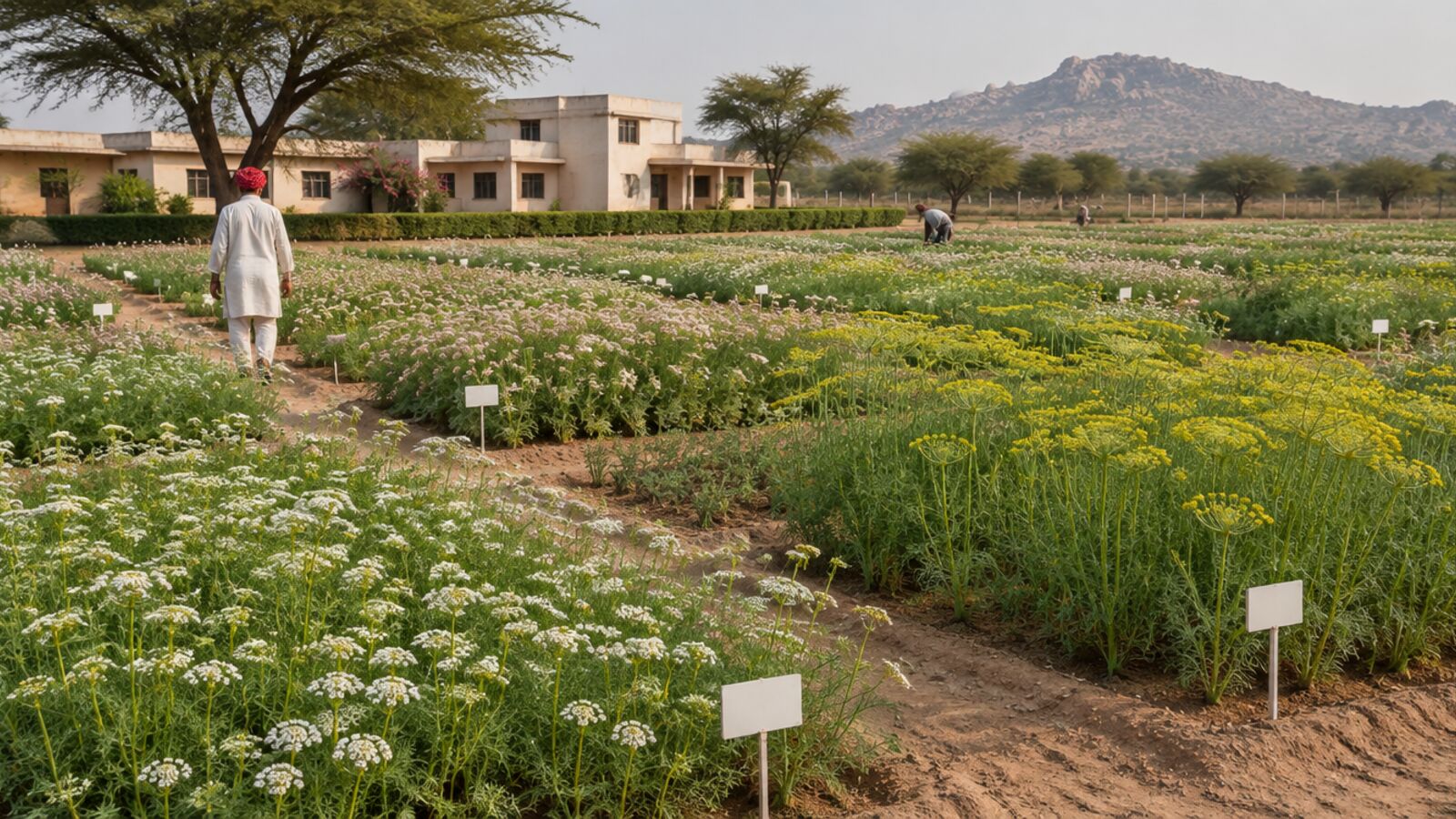
A new cumin variety, Jodhpur Jeera-1, recorded a mean seed yield of 566 kg per hectare in multi-location trials, 22.8% more than the national check variety GC-4 at 469 kg/ha, according to a paper by Agriculture University Jodhpur researchers published in 2026 [1]. The variety was recommended for irrigated, timely sown rabi cultivation in Rajasthan in 2025 [1].
New seed matters to the jeera (cumin) and dhania (coriander) trade because yields set how much each hectare adds to supply. In a year when dry soils and El Nino threaten the 2027 crop, varieties that tolerate disease and give more oil per kilogram decide what growers earn and what exporters can ship to grade.
Jodhpur Jeera-1 targets yield and oil
Jodhpur Jeera-1, coded MCU-105, was selected from local germplasm collected in Nagaur district and tested under the All India Coordinated Research Project on Spices at five sites in Rajasthan and Gujarat from 2021-22 to 2023-24 [1]. Its essential oil content was 4.34% [1]. It matures in 118 to 138 days [1].
The authors report moderate resistance to Fusarium wilt and Alternaria blight, with mean blight incidence of 26.0% against 34.4% for GC-4 [1]. Alternaria blight can cut cumin yields by 50% to 80% in humid, cloudy weather, the paper notes [1].
| Variety or technology | Crop | Key result | Source |
|---|---|---|---|
| Jodhpur Jeera-1 (MCU-105) | Cumin | 566 kg/ha, +22.8% over GC-4 | [1] |
| Karan Dhaniya-1 (RCr-565) | Coriander | Notified 8 Jul 2026 for eight states | [2] |
| Navsari Krupali (GCo 5) | Coriander | Notified 8 Jul 2026 for Gujarat | [2] |
| Ajmer Fennel-2 (AF-2) | Fennel | 17.9 q/ha in national trials | [3] |
| Seed biopriming | Cumin | 426 to 516 kg/ha on farms | [4] |
Three coriander varieties gain national notification
A Ministry of Agriculture notification, S.O. 3708(E) dated 8 July 2026, notified three coriander varieties under the Seeds Act: Karan Dhaniya-1 (RCr-565), recommended for Rajasthan, Gujarat, Uttar Pradesh, Bihar, Madhya Pradesh, Andhra Pradesh, Chhattisgarh and Tamil Nadu [2]. It also notified Navsari Krupali (GCo 5) and Navsari Surabhi (GLC-2) for Gujarat [2]. The same notification listed fenugreek variety Karan Methi-1 (RMt-259) for eight states [2]. It named no new cumin variety [2].
The notification does not list yields or developers [2]. Notification is the step that allows certified seed of a variety to be produced and sold, so the impact on dhania supply depends on how quickly seed multiplies.
Old varieties still dominate the seed chain
That is where seed spices lag. A study by ICAR-National Research Centre on Seed Spices (NRCSS) scientists found that only 2 cumin varieties received breeder seed indents in the decade to 2023-24, against 29 in coriander and 19 in fenugreek [5]. GC-4 dominated cumin indents while RCr-436 and RCr-435 led coriander [5].
The study projected a seed replacement rate from the formal chain of 5.27% in cumin and 48.16% in coriander for 2025-26 [5]. Most cumin growers therefore still sow saved seed. Private seed companies accounted for 24% of coriander breeder seed indents, while cumin demand was met entirely by public agencies [5].
NRCSS is pushing adoption on farms
NRCSS has focused on demonstrations. In 10 front-line demonstrations across seven villages of Ajmer district in rabi 2025, seed biopriming with chitosan and two bacterial strains raised cumin germination from 70.22% to 82.08% and yield from 426.0 to 516.0 kg/ha, a 21.1% gain [4]. The extra cost was Rs 900 per hectare and the additional net return Rs 24,297 per hectare, the institute's scientists reported [4].
For fennel, NRCSS demonstrated its Ajmer Fennel-2 variety with 113 farmers in Pali and Sirohi districts in 2025-26 [3]. The variety averaged 17.9 quintals per hectare in national trials, 10.6% above check RF-205, with 1.9% essential oil; 87.6% of demonstration farmers said yield met expectations [3]. Only 5.3% saw better market demand for the produce, the paper found [3].
What the trade is watching
The first marker is breeder seed indents for Jodhpur Jeera-1 and Karan Dhaniya-1 in the 2027 seed plan. The second is whether biopriming moves beyond demonstrations into state seed programmes [4]. The third is whether processors pay premiums for higher-oil varieties, which the fennel study suggests markets do not yet reward [3].
Questions and answers
What is the most widely grown cumin variety in India?
GC-4 dominates. An ICAR-NRCSS study found it led cumin breeder seed indents over the decade to 2023-24. Only 2 cumin varieties received indents in that period.
Which new coriander varieties were notified in 2026?
A Ministry of Agriculture notification dated 8 July 2026 notified Karan Dhaniya-1 (RCr-565) for eight states and Navsari Krupali (GCo 5) and Navsari Surabhi (GLC-2) for Gujarat.
What is Jodhpur Jeera-1?
Jodhpur Jeera-1 (MCU-105) is a cumin variety from Agriculture University Jodhpur. It yielded 566 kg/ha in coordinated trials, 22.8% above GC-4, with 4.34% essential oil. It was recommended for Rajasthan in 2025.
Sources
- Indian Journal of Arid Horticulture 8(1) (Ramesh et al., Agriculture University Jodhpur). Jodhpur Jeera-1: High seed yielding variety of cumin for Rajasthan, Accepted 2026-04-30.
- Ministry of Agriculture and Farmers Welfare (Gazette of India). Notification S.O. 3708(E) under the Seeds Act, 1966, 2026-07-08.
- International Journal of Seed Spices 15(2) (Jangir et al., ICAR-NRCSS). Popularization and farmer-perceived field performance of the fennel variety Ajmer Fennel-2 (AF-2) in fennel-growing regions, Accepted 2026-07-30.
- International Journal of Seed Spices 16(1) (Jangir et al., ICAR-NRCSS). On-farm evaluation of seed biopriming technology for enhancing germination and seed yield of cumin, Accepted 2026-10-01.
- International Journal of Seed Spices 14(2) (Kumar et al., ICAR-NRCSS). Quantitative insights into breeder seed production trends and varietal adoption in major seed spices, Accepted 2025-08-18.
Analysis by the India Spices Market editorial desk. For information only, not trading or investment advice.
Related
More from Intelligence.
Supply chain
El Nino and dry soils slow rabi sowing in India's jeera and dhania belt
26 November 2026 · 4 min read
Supply chain
Monsoon 2026 ends 13% short, leaving dry soils for jeera and dhania sowing
26 November 2026 · 4 min read
Supply chain
Steam sterilisation and colour sorting become musts for spice exporters
26 November 2026 · 4 min read
Read the market here. Meet it in Gandhinagar.
Every topic on this page is on the programme on 24 April 2027, with the people who move these prices in the room.
Registration opens 1 December 2026