
Policy
Unjha jeera and fennel win GI tags, taking India's spice GIs to 47
Certificates dated 28 March 2026 make APMC Unjha proprietor of Unjha Jeera and Unjha Fennel. Their value will rest on authorised users and traceability.
Published · Data as of · 4 min read
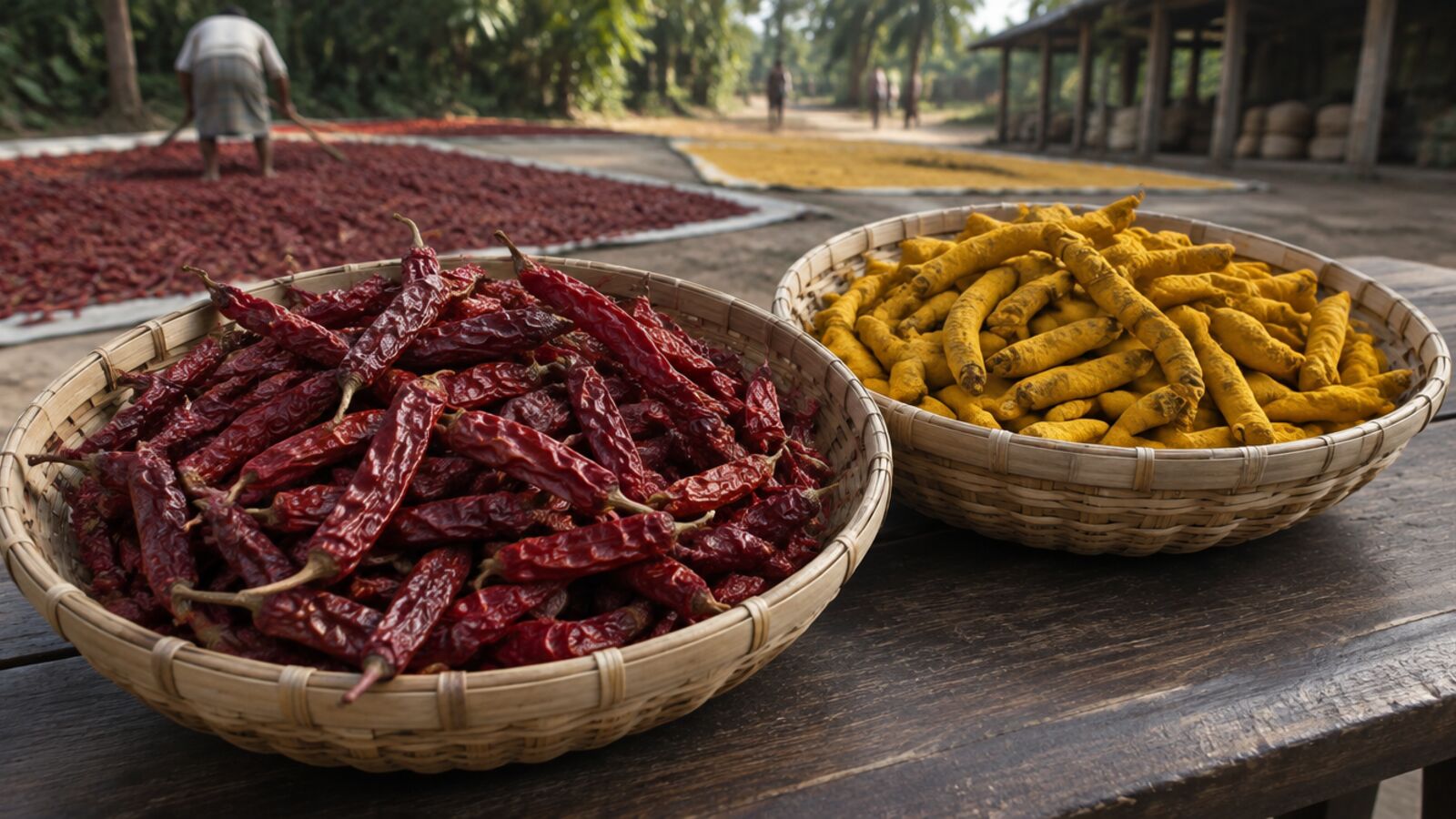
Unjha Jeera and Unjha Fennel received geographical indication certificates dated 28 March 2026, registered in the name of the Agriculture Produce Market Committee in Unjha and valid until 23 June 2034, according to Spices Board India's list of GI tags for spices [1]. The list, updated to 15 September 2026, now carries 47 spice GIs [1].
The tag is the first GI for jeera (cumin) from India's main seed spice market. Unjha hosts one of Asia's largest cumin markets [4], so the tag gives exporters a protected origin name at a time when the EU has raised border checks on Indian cumin to 50% [8].
What was registered in 2026
Three spice GIs carry certificate dates of 28 March 2026 in the Spices Board list: Unjha Jeera (application 1289), Unjha Fennel (application 1290) and Khargone Lal Mirch from Madhya Pradesh (application 1166) [1]. The Unjha tags were announced publicly in July 2026, when Gujarat Chief Minister Bhupendra Patel welcomed them on X, DeshGujarat reported [2].
The registration falls under Class 30 for spices, GK Today noted [3]. A September 2026 summary by Chronicle India said Unjha jeera is grown in a notified region of Gujarat from sea level to 400 feet above mean sea level and described oval, slightly curved seeds that are light to dark brown [5].
| Seed spice GI | Certificate date | Registered proprietor |
|---|---|---|
| Unjha Jeera | 28 March 2026 | APMC Unjha |
| Unjha Fennel | 28 March 2026 | APMC Unjha |
| Kasti Coriander | 30 March 2024 | Kasti Kotimbir Shetkari Utpadak Sangh, Latur |
| Himachali Kala Zeera | 4 March 2019 | Kalazeera Utpadan Sangh, Kinnaur |
Source: Spices Board India GI list as of 15 September 2026 [1].
APMC Unjha has also applied for a third product. Its application for Unjha Isabgol (psyllium), number 2106 in Class 31, was filed on 21 July 2026 and is listed as a new application on the GI Registry [6].
The wider spice GI list
India's spice GIs date back to Naga Mircha in 2003 and Malabar Pepper, Alleppey Green Cardamom and Coorg Green Cardamom in 2008, all of which remain registered [1]. Spices Board India is the proprietor of five of them: Malabar Pepper, Alleppey Green Cardamom, Coorg Green Cardamom, Guntur Sannam Chilli and Byadagi Chilli [7].
Recent additions have come mostly from producer groups and state agencies rather than the Board. The 2025 entries include Thalanadan Gramb (clove) from Kerala, Warangal Chapata Chilli from Telangana and Virudhunagar Samba Vattal chilli from Tamil Nadu [1].
A tag is only as useful as its users
A GI protects a name; it does not by itself raise prices. Under the Spices Board's guidelines for its own GIs, producers must register as authorised users with the GI Registry, with land records, production details and an objection-free notice in the GI Journal, before they can market the produce under the GI [7]. Authorised user certificates last 10 years. Producers must also keep records of area, output, lots and buyers for each season [7].
Unjha's trade leaders expect the tag to lift demand. APMC Unjha chairman Dinesh Patel told ANI that the products would gain wider recognition and better returns for farmers and traders, as carried by The News Mill [4]. The same report said Mehsana district exported spices worth about Rs 3,995 crore to 101 countries in 2024-25, with China taking 25%, Bangladesh 16% and the UAE 10% [4].
What to watch
The practical questions are how many farmers and traders register as authorised users of Unjha Jeera and whether exporters build GI-labelled, traceable lots for the EU, where Indian cumin faces 50% border checks for pesticide residues [8]. A GI-certified, tested lot could command a premium; an untested GI lot would carry the same compliance risk as any other.
India exported 196,800 tonnes of cumin in 2025-26 [9]. Even a small branded GI segment of that trade would be a first for seed spices, which are still sold almost entirely as bulk commodities.
Questions and answers
Has Unjha jeera received a GI tag?
Yes. Unjha Jeera received a geographical indication certificate dated 28 March 2026, registered to APMC Unjha and valid until 23 June 2034, according to Spices Board India. Unjha Fennel received a GI on the same date.
How many spice GI tags does India have?
Spices Board India lists 47 geographical indications registered for spices as of 15 September 2026. They range from Malabar Pepper and Alleppey Green Cardamom to Kasti Coriander, Unjha Jeera and Khargone Lal Mirch.
How can farmers use a spice GI tag?
Producers must register as authorised users with the GI Registry, submitting land records and production details. The certificate is valid for 10 years. Users must keep records of area, output and buyers.
Sources
- Spices Board India. List of Geographical Indication (GI) tags registered for spices (as of 15/09/2026), 2026-09-15.
- DeshGujarat. Unjha Jeera, fennel secure GI tag, 2026-07-13.
- GK Today. Gujarat's Unjha cumin and fennel get GI tags, 2026-07.
- The News Mill (ANI). Unjha cumin and fennel awarded GI tag to boost Gujarat's spice exports, 2026-07-28.
- Chronicle India. Unjha cumin (CSCE September 2026), 2026-09.
- GI Registry, Intellectual Property India. Application details: Unjha Isabgol (application 2106), 2026-07-21.
- Spices Board India. Guidelines for obtaining GI Authorised User Certificate from GI Registry for GI obtained by Spices Board (Circular MKTG/GI/01/2021-22), 2021-05-06.
- European Commission (copy hosted by the Icelandic Food and Veterinary Authority). Commission Implementing Regulation (EU) 2026/1206 of 9 June 2026, 2026-06-09.
- Spices Board India. Item-wise export of spices from India, 2021-22 to 2025-26 (source: DGCI&S, Calcutta / MoC), 2026.
Analysis by the India Spices Market editorial desk. For information only, not trading or investment advice.
Related
More from Intelligence.

Policy
EU raises border checks on Indian cumin to 50% after pesticide failures
26 November 2026 · 4 min read
Policy
UK requires official certificates for Indian seed spices from January 2026
26 November 2026 · 4 min read
Policy
EU drops ethylene oxide certificate for Indian chilli and pepper in 2026
26 November 2026 · 4 min read
Read the market here. Meet it in Gandhinagar.
Every topic on this page is on the programme on 24 April 2027, with the people who move these prices in the room.
Registration opens 1 December 2026