
Markets
Gulf buys over a quarter of India's spice exports as Saudi demand climbs
Saudi purchases of Indian spices rose 16.6% by value in 2025-26 while the UAE fell 6.9%, even as the Hormuz disruption tested Gulf shipping routes.
Published · Data as of · 4 min read
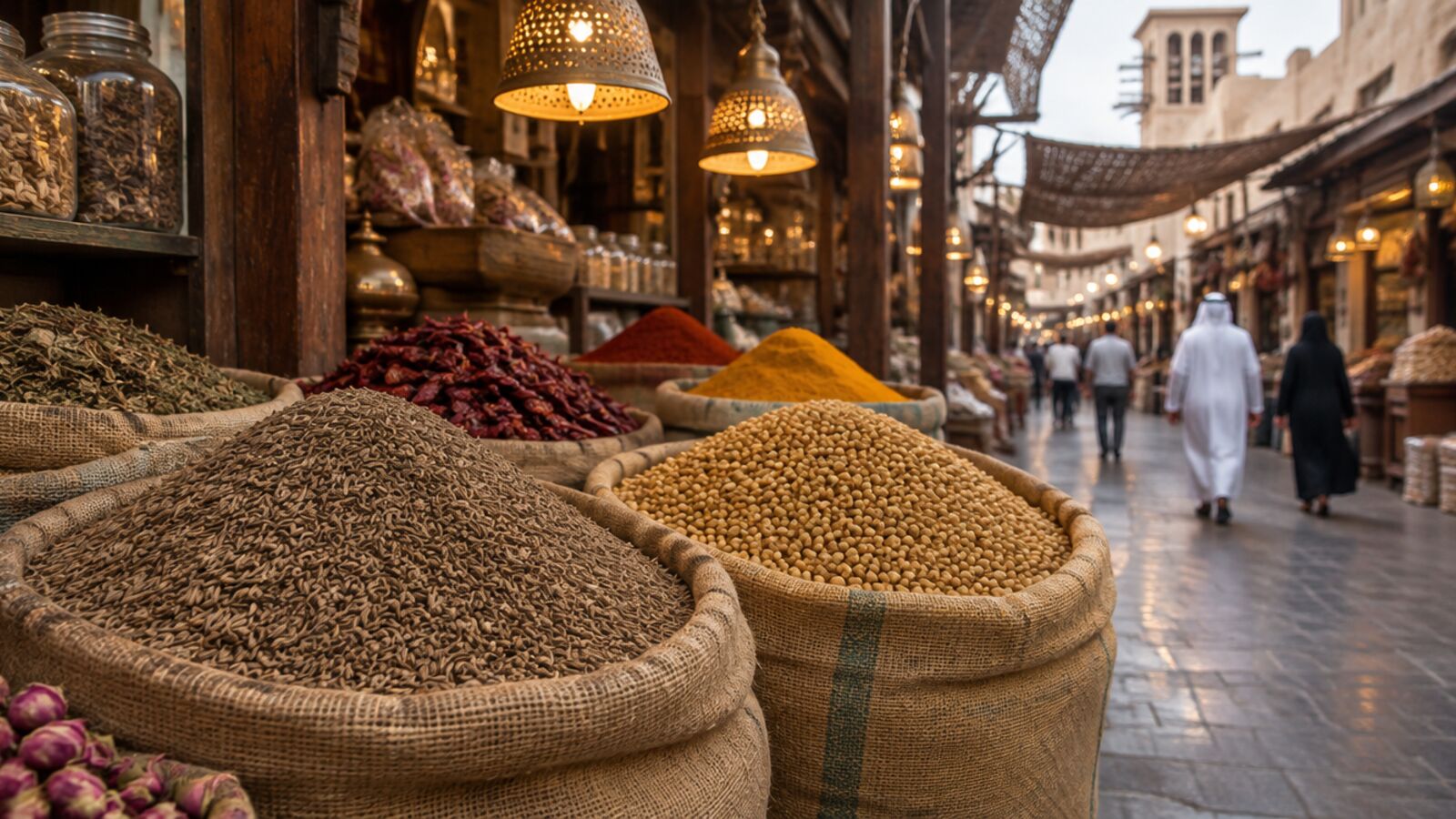
Gulf countries buy more than a quarter of India's spices by value. In 2025-26 Saudi Arabia was the fastest-growing of them, with Indian spice exports to the kingdom up 16.56% in value while those to the UAE fell 6.87%, according to a study by Meena and colleagues in the International Journal of Seed Spices, based on Spices Board India data [1]. The study says the region contributes more than 26% of India's spice export earnings [1].
That concentration matters for jeera (cumin) and dhania (coriander) traders because most Gulf cargo moves through or near the Strait of Hormuz, which was disrupted by the conflict involving Iran in 2026 [1]. The authors note that the Gulf's share of India's cumin exports rose to about 19% in 2024-25 from less than 9% in 2020-21 [1].
Saudi Arabia rises as the UAE slips
The study's country table, compiled from Spices Board India data, shows the UAE remained the largest Gulf importer of Indian spices throughout 2021-22 to 2025-26, with volumes and values almost doubling over the period, but its value fell 6.87% in 2025-26 [1]. Saudi Arabia's value rose 16.56% and Oman's 18.33%, while Qatar fell 26.24% and Kuwait 11.85% [1].
| Indian spice exports, 2025-26 vs 2024-25 | Change in value |
|---|---|
| Saudi Arabia | +16.56% |
| Oman | +18.33% |
| UAE | -6.87% |
| Kuwait | -11.85% |
| Qatar | -26.24% |
Source: Meena et al., International Journal of Seed Spices, based on Spices Board India data [1].
The Gulf's role in cumin has grown fast. On the study's figures, the region's share of Indian cumin exports more than doubled between 2020-21 and 2024-25, which the authors describe as a growing share for the region [1].
For seed spices, the Gulf's weight is growing. The GCC took 21.03% of India's seed spice export value in 2025-26, against 19.58% in 2024-25 [1]. Within that, cumin exports to the GCC fell 4.14% in volume and 17.21% in value, while coriander fell 2.09% in volume but rose 1.82% in value [1].
Cardamom and branded spices drove growth
Much of the Saudi increase came from cardamom. Saudi Arabia took 3,994 tonnes of Indian small cardamom worth US$123.32 million in 2025-26, up from 1,458 tonnes worth US$41.72 million, while the UAE took 3,941 tonnes worth US$117.68 million, up from 2,328 tonnes, Tradologie reported [2]. Gulf buyers turned to India after Guatemala's crop failure [3].
Branded spices are also growing in the region. Orkla India, which owns the Eastern brand, said its GCC business grew 22.7% in the July to September 2026 quarter [4]. Its management said in May 2026 that the GCC makes up about 70% of its international business [5].
The Hormuz disruption hit some trades harder
The conflict involving Iran in early 2026 disrupted shipments. Telangana Today reported on 23 March 2026 that turmeric exports to Gulf countries slowed after the conflict began, pushing Telangana and Maharashtra prices down by about Rs 2,000 per quintal [6]. Cardamom buyers accepted higher freight and used alternative routes to avoid the Strait, Agronom.info reported in May [3].
Orkla India cited higher freight costs, port closures and longer transit times on Gulf routes in May 2026, while saying shelves stayed stocked [5]. Demand has since returned in some lines. The Hans India reported on 19 November 2026 that export orders from Gulf countries, Bangladesh and Malaysia had pushed Nizamabad turmeric to a record Rs 28,000 per quintal [7].
What it means for the trade
The study's authors describe the Gulf as a source of both growth and risk: a prolonged disruption in the Strait of Hormuz could reduce export competitiveness and hurt farmers, exporters and processors, they wrote [1]. They also caution that changes in 2025-26 reflect freight, demand, prices and exchange rates as well as the conflict [1].
For jeera and dhania exporters, the Gulf is a market where cumin volumes have held up better than values, with GCC cumin volume down 4.14% against a 17.21% fall in value [1]. The signals to watch are Ramadan buying in early 2027, freight rates on Gulf routes and whether Saudi Arabia's growth in cardamom and branded products extends to seed spices.
Questions and answers
How important is the Gulf for Indian spice exports?
Gulf countries account for more than 26% of India's spice export earnings, according to an ICAR-published study of Spices Board India data. The UAE is the largest Gulf buyer, while Saudi Arabia grew fastest in 2025-26.
Did Gulf demand for Indian cumin fall in 2025-26?
Yes. Cumin exports to GCC countries fell 4.14% in volume and 17.21% in value in 2025-26, the study estimates. Coriander exports to the region fell 2.09% in volume but rose 1.82% in value.
How did the 2026 Strait of Hormuz disruption affect spice trade?
It slowed shipments to the Gulf in early 2026, with turmeric prices in Telangana and Maharashtra falling about Rs 2,000 per quintal in March. Cardamom buyers paid higher freight and used alternative routes.
Sources
- Meena et al., International Journal of Seed Spices 16(1): 69-79 (ICAR). India's seed spice exports amid geopolitical disruptions, 2026.
- Tradologie. SPICED scheme extended (small cardamom export destinations), 2026-07-11.
- Agronom.info (citing The Hindu BusinessLine). Indian cardamom exports surge as Guatemala crop failure redirects demand, 2026-05-19.
- Orkla India Limited (filed with NSE). Transcript of Q2 FY27 earnings conference call, 2026-11-04.
- Orkla India Limited. Transcript of Q4 FY26 earnings conference call, 2026-05-19.
- Telangana Today. Export slowdown hits turmeric farmers in Telangana and Maharashtra, 2026-03-23.
- The Hans India. Nizamabad turmeric prices soar to record Rs 28,000 per quintal on export demand, 2026-11-19.
Analysis by the India Spices Market editorial desk. For information only, not trading or investment advice.
Related
More from Intelligence.
Markets
Bangladesh becomes top buyer of Indian jeera as China cuts purchases
26 November 2026 · 4 min read
Markets
US becomes top Indian spice market even as its purchases fall 12%
26 November 2026 · 4 min read
Markets
China cuts Indian spice buying 32% and turns rival in chilli and cumin
26 November 2026 · 4 min read
Read the market here. Meet it in Gandhinagar.
Every topic on this page is on the programme on 24 April 2027, with the people who move these prices in the room.
Registration opens 1 December 2026