
Jeera
China's home-grown cumin cuts Indian shipments to 9,271 tonnes
Trade estimates put China's cumin crop at 55,000 to 90,000 tonnes, close to its own use. Indian sales there fell 76% in 2025-26 before a late-2026 revival.
Published · Data as of · 5 min read
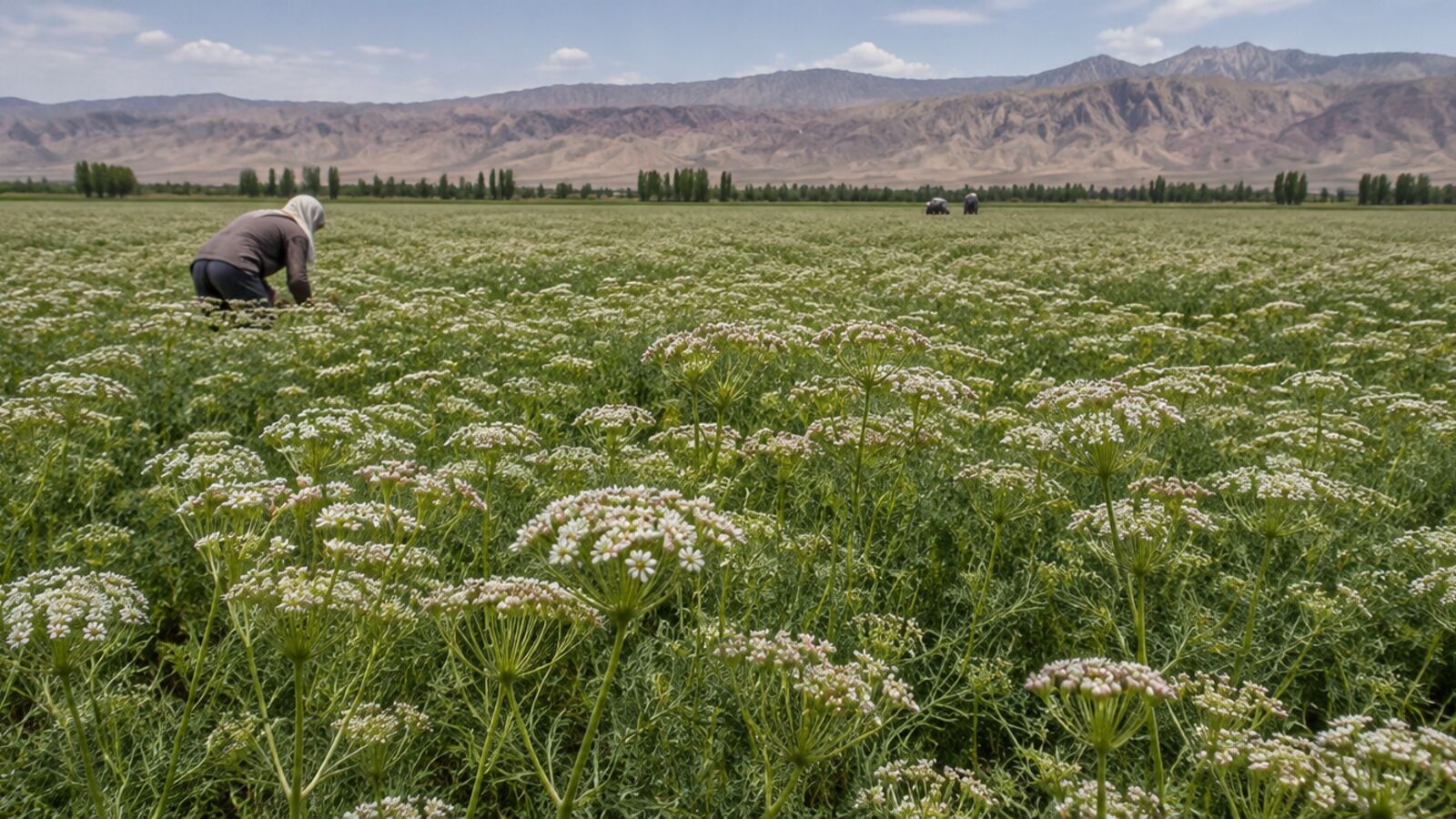
China's expanding cumin crop has removed India's most volatile export customer. Indian jeera (cumin) shipments to China fell to 9,271 tonnes in 2025-26 from 38,721 tonnes in 2024-25, a drop of about 76% [1][6]. An Indian exporter quoted by The Hindu BusinessLine put China's 2025 harvest at around 85,000 to 90,000 tonnes, enough to avoid heavy buying from India [2].
For the Indian trade the question is no longer only how big the Gujarat and Rajasthan crop is. China now grows a large part of what it eats, so its purchases depend on its own harvest and on whether Indian prices are low enough to tempt importers. That makes China a swing buyer rather than a steady one.
Estimates of China's crop vary widely
No official Chinese production figure appears in the sources reviewed. Trade numbers differ. Ajay Kedia of Kedia Capital told Informist in January 2026 that Chinese output rose to around 60,000 tonnes in 2023-24 from 15,000 to 20,000 tonnes earlier, after high Indian prices encouraged sowing [3]. BigMint wrote in March 2026 that Chinese production had reportedly risen to 55,000 tonnes from 15,000 to 18,000 tonnes [5]. The BusinessLine source gave the higher 85,000 to 90,000 tonne figure for 2025 [2].
| Source | Measure | Figure |
|---|---|---|
| Kedia Capital, via Informist [3] | China output, 2023-24 | about 60,000 t |
| BigMint, March 2026 [5] | China output, as reported | 55,000 t |
| SpicExim, via BusinessLine [2] | China harvest, 2025 | 85,000 to 90,000 t |
| BigMint, February 2026 [4] | China annual consumption | 70,000 to 80,000 t |
Set against BigMint's estimate of Chinese consumption at 70,000 to 80,000 tonnes a year, the higher crop figure would cover most domestic need without imports [2][4]. The lower figures would leave a gap of 10,000 to 25,000 tonnes (calculated), still well below the 38,721 tonnes China took from India in 2024-25 [1].
Much of the crop is grown in Xinjiang. Chinese state broadcaster CGTN reported in June 2026 that more than 23,300 hectares of cumin were being harvested by machine in Yuepuhu County alone [7].
A later harvest shapes the second half of the year
China's crop reaches the market after India's. BigMint said the Chinese harvest arrives around May and June, against March and April in India, so its outcome influences cumin prices in the second half of the year [5]. A separate BigMint report put the Chinese new crop in July and August [4]. Kedia said Chinese sowing starts in February and that clearer signals come only by April [3].
That timing showed in the trade data. BigMint reported that India shipped 490 tonnes to China in January to March 2026, against 6,691 tonnes a year earlier [8]. A Commodity Board report for the same quarter gave a much higher figure of about 8,353 tonnes [9]. The two numbers cannot both be right and neither report names its customs source. Both show a steep fall.
China is also a competitor
Traders increasingly describe China as a seller as well as a buyer. Commodity Board wrote in April 2026 that China was managing its own inventories and expanding its role as an exporter [9]. In June it reported that China was again expected to harvest a relatively large crop, helped by weather and better farm practices. It added that Syrian output was forecast to improve [10]. It said this would cap India's ability to charge premiums [10].
BigMint suggested a price trigger for Chinese buying. It wrote in February 2026 that if Indian prices softened toward Rs 21,000 to 22,000 per quintal, Chinese buying could return before the new harvest [4]. Unjha jeera traded at about Rs 19,500 to 19,900 per quintal in late August and early September 2026, below that band, Commodity Board reported [14].
Demand revived in late 2026, with compliance strings attached
The latest reports point to a partial return. Commodity Board said on 13 November 2026 that demand from China and West Asia had rebounded over the past six weeks, with Indian exports up a reported 25% to 26% in that period [11]. It also said China was gradually expanding its own production [11]. The report does not give a tonnage for China.
Exporters selling to China face tighter checks. The Spices Board warned in June 2026 that some Indian spice consignments had failed Chinese pesticide residue limits and that continued non-compliance could lead to suspension of DAPQ or CIFER registration, which exporters need to ship to China [12]. A further advisory dated 12 November 2026 told exporters that the production address on labels must match the address registered with China's customs authority, GACC [13].
What to watch
Three markers will show whether China's retreat is lasting. The first is the size of the 2027 Chinese crop, which will be clearer by April. The second is whether Indian prices move back toward levels that trigger Chinese buying. The third is compliance: a registration suspension would shut the market regardless of price.
Questions and answers
How much cumin does China produce?
There is no single agreed figure. Trade estimates range from about 55,000 tonnes, reported by BigMint, to 85,000 to 90,000 tonnes for 2025, cited by an Indian exporter in The Hindu BusinessLine [2][5].
Why did China stop buying Indian jeera in 2025-26?
China harvested a large domestic crop that covered most of its needs, so imports from India fell to 9,271 tonnes from 38,721 tonnes [1][2]. Indian exporters also faced Chinese residue and registration checks flagged by the Spices Board [12].
Is China buying Indian cumin again?
Commodity Board reported on 13 November 2026 that demand from China and West Asia had rebounded over six weeks [11]. It did not give a tonnage, so the scale of the return is not yet clear.
Sources
- Commodity Board (CMB News). Cumin Trade Under Pressure as India Faces Export Slump and Shifting Demand, 2026-08-03.
- Agronom.info, reporting The Hindu BusinessLine. Indian cumin exports drop sharply as Chinese buying slumps, 2026-06-21.
- Informist. TREND: After long slump, jeera seen rebounding on acreage fall, demand rise, 2026-01-27.
- BigMint. Cumin enters tight supply phase as crop acreage shrinks and demand stays firm, 2026-02-23.
- BigMint. China emerging as new competitor to India in global cumin trade, 2026-03-11.
- International Journal of Seed Spices (ICAR), Meena et al.. India's Seed Spice Exports amid Geopolitical Disruptions, Vol. 16(1): 69-79, June 2026.
- CGTN. Xinjiang's cumin harvest is speeding up, 2026-06-13.
- BigMint. India: Jeera market weakens as export slowdown and rising arrivals pressure prices, 2026-04-14.
- Commodity Board (CMB News). Cumin market cools as China steps back and Indian supply builds, 2026-04-22.
- Commodity Board (CMB News). Muted Cumin Demand Weighs on Indian Exports as China Steps Back, 2026-06-22.
- Commodity Board (CMB News). Indian Cumin Prices Rebound as Dry Soils and Export Buying Tighten the Market, 2026-11-13.
- Spices Board India. Trade Advisory 03/2026-27: Advisory to exporters of spices and spice products to China, 2026-06-23.
- Spices Board India. Trade Advisory 05/2026-27: Compliance with GACC registration and labelling requirements for export of spices to China under CIFER/DAPQ, 2026-11-12.
- Commodity Board (CMB News). Cumin Prices Hold Firm as Indian Export Slowdown Offsets Tight Syrian, Egyptian Supply, 2026-09-03.
Analysis by the India Spices Market editorial desk. For information only, not trading or investment advice.
Related
More from Intelligence.
Jeera
India's jeera exports fall 14% in 2025-26 as China cuts purchases 76%
26 November 2026 · 5 min read
Jeera
Turkey's purchases of Indian cumin jump nearly eightfold to 7,529 tonnes
26 November 2026 · 5 min read
Jeera
Gujarat jeera sowing at 74,278 ha, up 3.5% after last season's 14% drop
26 November 2026 · 5 min read
Read the market here. Meet it in Gandhinagar.
Every topic on this page is on the programme on 24 April 2027, with the people who move these prices in the room.
Registration opens 1 December 2026